While it’s certainly not a household name in the same way Bitcoin is, there’s no denying that Litecoin has, in a similar vein, been a major disruptor in both the worlds of finance and tech. It was created back in 2011 and now has a loyal following around the globe, with people vying to trade and invest in the currency in the same way they do other forms of crypto.
But what exactly is Litecoin, and who created it? What sets it apart from Bitcoin, and what can it do better? In this article, we’ll be exploring all of this and more, so read on!
Table of Contents
Discover The History of Litecoin
Origins: The Creation of Litecoin
Since it was initially developed in 2011, Litecoin has gone on to become one of the biggest and most popular altcoins out there. It has just about as many applications as Bitcoin does, too, with people using it for investing, trading or even enjoying Litecoin casino games These activities are just a few options of Litecoin possibilities.
It was Charlie Lee who first created Litecoin. Lee graduated from MIT and went on to work at Google before putting his attention towards developing a new cryptocurrency. It’s fair to say that Litecoin is more or less based on Bitcoin; Lee actually used Bitcoin’s code as a foundation for Litecoin, though he modified it in a number of keyways while doing so.
Thanks to the way it was first deployed, Litecoin was able to attract a significant amount of interest in the same sectors that Bitcoin was. Early supporters enjoyed the idea of being able to support one of Bitcoin’s competitors, potentially heading off a monopoly of sorts (though, of course, Bitcoin has gone on to dominate the market anyway).
Before long, crypto enthusiasts were buying and trading Litecoin in big numbers. While it never managed to hold quite as much sway as Bitcoin has, the altcoin has certainly held its own in the market. As is typical of trading cryptocurrency, Litecoin’s value has fluctuated pretty dramatically since its launch.
Of course, buying cryptocurrency isn’t exactly something that you should take lightly. It carries its own risks with it, and these need to be taken into consideration every time you put any of your hard-earned cash towards buying crypto. Of course, provided that you know what you’re doing, buying, and selling cryptocurrencies like Litecoin can be a very lucrative way to earn some money on the side (or, indeed, a full-time gig if you so choose).
How Litecoin Developed into One of Bitcoin’s Fiercest Competitors (and Its Subsequent Decline)
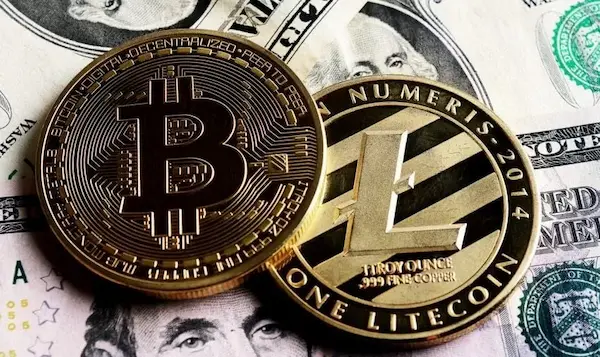
While Litecoin may be seen as a Bitcoin derivative by some, it’s worthwhile pointing out that it does have many of its own strengths. For one, Litecoin is faster to trade and receive than Bitcoin, something that is valued by many of its supporters. It also supports faster block generation than Bitcoin does.
Nevertheless, Litecoin was essentially launched for the purpose of acting as a sort of ‘light’ version of Bitcoin. It’s been used for testing out improvements and features that would later be applied to Bitcoin itself. In fact, Litecoin can be named “the silver equivalent” to Bitcoin’s gold.
At the peak of its growth, Litecoin was the third-largest cryptocurrency in the world based on market cap. This just goes to show that, despite having been created out of the foundations of Bitcoin, Litecoin has certainly been no slouch; it’s created its own value and shown that it has its own strengths, too.
With this being said, it’s important to point out that Litecoin isn’t actually as popular as it once was. When it was first launched, Litecoin was a pretty major success among tech enthusiasts, who adopted it in much the same way and for the same reasons that they did Bitcoin. However, as the Bitcoin market has grown, it’s also become increasingly saturated.
Because of this, Litecoin’s popularity has more or less been in decline in recent years. While this isn’t a result of any deficits with Litecoin as a product, per se, the outcome has been fairly major. A greater number of competitors means that there are fewer Litecoin diehards; other cryptocurrencies that do more to set themselves apart from Bitcoin, like Ethereum, are seeing more consistent growth and interest across different markets.
In more recent years, Litecoin has been adopted by payment platforms like PayPal, or integrated into different modes of transaction, proving that its relevance is yet to completely fade away. And, in 2021, a fake press release claimed that Walmart and Litecoin were launching a partnership of sorts, which dramatically (though temporarily) boosted the value of the altcoin.
Conclusion
All in all, Litecoin’s future seems, at present, somewhat uncertain. While the cryptocurrency’s value is far from being what it once was, this is no guarantee that Litecoin may not be able to claim back some of the relevance and influence it once held in the tech and finance spheres. Only time will tell!